CoggoPod: The Exam Room Recorder You Wear
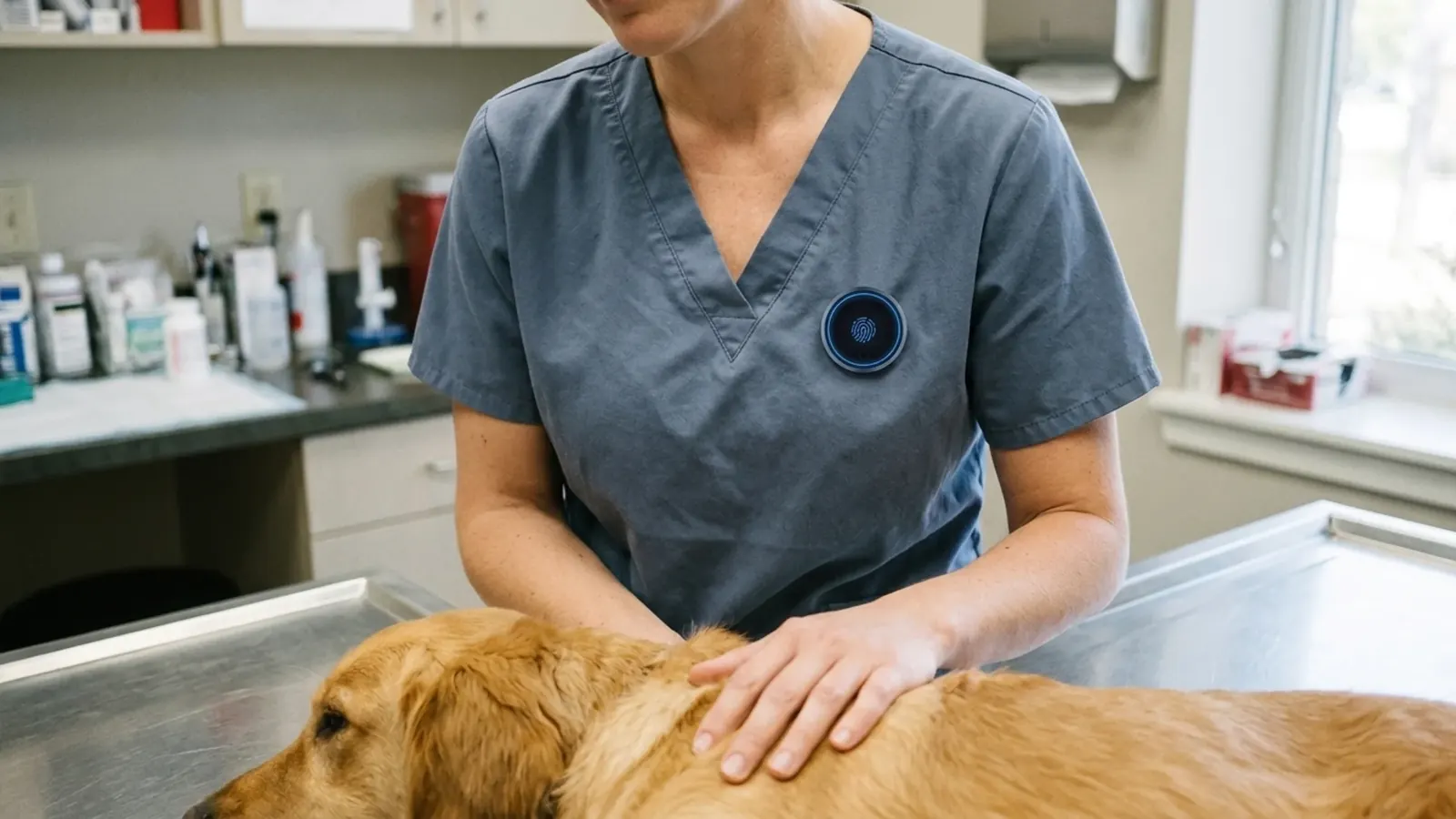
Most AI scribes start with the same instruction: put your phone in the room and press record. CoggoPod starts somewhere else. It is a recorder you wear, so the phone can stay in your pocket, in the truck or at the front desk.
What CoggoPod is
CoggoPod is a round recorder, 1.8 inches across and 0.97 oz, made of aluminum and glass. It clips to your scrubs with a magnet or hangs on a lanyard. On the front is a fingerprint icon, which is the only control you need during a consult. Inside are two microphones, a battery that records for 18 to 20 hours, and 8 GB of storage, enough for about 1,000 hours of consultations.
It works with Coggo, the voice-first veterinary AI scribe, on iPhone and Android.
One consult, start to finish
- Clip it on. Before the consult, snap the pod onto your scrubs, close to where you speak, or slip the lanyard over your head.
- Touch to record. Rest a finger on the fingerprint for a second. The light turns steady blue and the pod is recording.
- Examine the patient. Talk through your findings the way you already do. Say the vitals out loud: “temp 101.3, heart rate 120, weight 62 pounds.”
- Touch to stop. The light flashes pink and the recording is saved on the pod, even with no phone in the room.
- Coggo syncs it. When your phone is nearby with Coggo open, the recording is copied to your clinic automatically.
- Assign and review. Pick the patient. Coggo transcribes the visit and drafts the SOAP note, with vitals already in the Objective section. You check it and approve it.
The light tells you what it is doing
| Light | Meaning |
|---|---|
| Flashing pink | On and ready, not recording |
| Steady blue | Recording |
| Steady red | Connected to the Coggo app |
| Flashing red | Charging |
Why wear your recorder
Your hands stay on the patient. There is no screen to unlock and no app to open mid-exam. A touch starts the recording and a touch stops it.
The audio is closer to you. A pod on your chest hears you more clearly than a phone in a pocket, and the two microphones pick up the client’s history too.
The phone stops being part of the consult. No notifications on the exam table, no phone left behind when you carry the patient to radiology, no battery drained by a day of recording.
It keeps up with long days. 18 to 20 hours per charge covers a full clinic day with room to spare, and 20 days of standby means a pod in a drawer is ready when you pick it up.
Built for one clinic
A recorder you carry around needs to be safe to lose sight of for a minute. Each CoggoPod is registered to one clinic at a time, and only that clinic’s team can see its recordings. Recordings are encrypted in transit and at rest, and never used to train AI models. The note is never final until you have checked and approved it.
Specifications
| Size | 1.8 in (45 mm) diameter |
| Weight | 0.97 oz (27.6 g) |
| Materials | Aluminum alloy and glass |
| Microphones | 2 MEMS silicon microphones |
| Recording time | 18 to 20 hours per charge |
| Standby | Up to 20 days |
| Storage | 8 GB, about 1,000 hours |
| Battery | 250 mAh rechargeable |
| Charging | USB-C, about 1.5 hours |
| Wireless | Bluetooth 5.3 |
| App | Coggo for iPhone and Android |
| In the box | CoggoPod, magnetic clip, lanyard, USB-C cable, guide |
Keep it dry: CoggoPod is not waterproof, so wipe it with a soft, dry or slightly damp cloth and keep it away from liquids.
What happens to the recording
CoggoPod is the front end of Coggo. Once a recording syncs, Coggo writes the note in about 20 seconds using 150 specialty templates across 14 species, from a canine wellness exam to an equine lameness workup. It pulls vitals out of what you said, reads attached x-rays and lab PDFs on Pro, and can write the note in 10 languages. You can still record from the Coggo app or turn a phone call into a SOAP note; CoggoPod is the third way to record.
How to get one
Email sales@coggo.ai for pricing for your clinic, or see it in person at AAEP 2026 (Las Vegas, December 7 to 11, Booths 2458 and 2460) and VMX 2027 (Orlando, January 16 to 20, Booth 2050). Comparing options? Read wearable recorders for veterinary AI scribes, compared, or see everything on the CoggoPod page.